Material Control System(MCS)
Automated material control solution maximizes operational efficiency by controlling material transfer and storage through logistics machine connectivity.
*Nexplant MCS is a Samsung SDS solution.- MCS : Material Control System
- It is a logistics control system that optimizes logistics travel time by managing transfer orders given to logistics equipment.
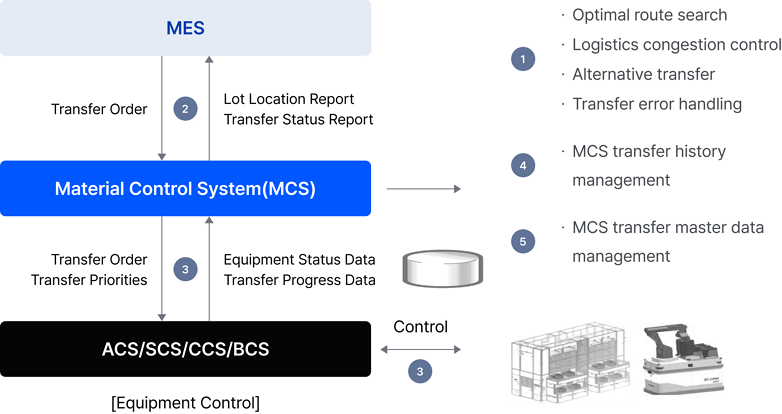
Key Functions
Logistics transfer control: Optimal route search, logistics congestion control, transfer error handling, alternative transfer etc.
Upper-level Host (MES) Interface
Low-level logistics equipment control (ACS, SCS, CCS, BCS)
Logistics transfer history: track records ranging from machine to transfer data to carrier location
Management of Logistics transfer standard data
- number 1 Logistics transfer control: Optimal route search, logistics congestion control, transfer error handling, alternative transfer etc.
- number 2Upper-level Host (MES) Interface
- number 3Low-level logistics equipment control (ACS, SCS, CCS, BCS)
- number 4Logistics transfer history: track records ranging from machine to transfer data to carrier location
- number 5Management of Logistics transfer standard data


 A leading global memory chipmaker needed to maintain a high level of cleanliness when transporting wafers
to each process manufacturing machines. To accomplish this, we built an automated wafer logistics system utilizing
overhead hoist transport (OHT) facilities.
They travel on their own according to the process sequence that each product must go
through, and the central system control room handles the OHT routes, times, and movements,
providing a bird's eye view of the movements of all OHT devices. The logistics automation
system for the semiconductor manufacturing line enabled a smooth process flow, increasing
semiconductor quality levels and production efficiency.
 A global secondary battery company had high manpower dependence due to the nature of battery manufacturing and proceeded many manual tasks. To address this, they used autonomous guided vehicles (AGVs) to improved process of assembly, notching, stacking, and so forth. They were able to increase the firm's productivity by semi-automating their electric vehicle battery production line, which helped the firm become profitable in battery business where cost reduction is difficult.
 A comprehensive online retailer built digital fulfillment centers (DFCs) in six offline stores to enhance sales competitiveness. By applying a model that automated some parts of the picking, sorting, and delivery process to each of brick-and-mortar stores, they were able to offer their customers "same-day delivery," and "fresh delivery" (delivery within 2 hours of their neighborhood), as well as their first "drive-through" pickup service. Through Miracom's logistics automation, the customer has been able to speed up their work, minimize misclassification, and enhance their work efficiency.
 A domestic company specializing in manufacturing industrial fasteners was planning to relocate its product warehouse to a new site. Due to the nature of the product, high proportion of heavy goods made worker fatigue high and low storage efficiency low. There was issues that efficiency got lower due to paper-based logistics operations. In addition, the new site required about twice the storage volume as the current one in a limited space, so we proposed and built a stacker crane — automated warehouse optimized for the customer's operation. This allowed them to maximize storage within their footprint, allowing for faster warehousing and releasing flow and enabling flexible logistics operations